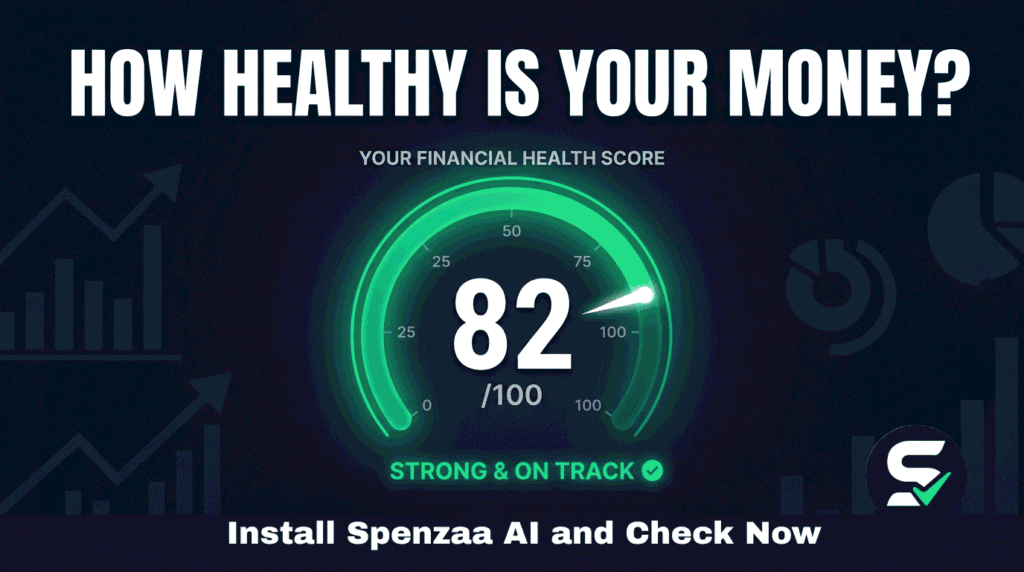
If someone asked you right now, “How healthy is your money?” — could you answer with a number?
Most people can’t. We know our weight, our blood pressure, maybe even our credit score. But when it comes to the actual health of our finances, most of us are running on a vague feeling of “I think I’m okay” or “I’m probably not saving enough.”
That’s exactly the gap a financial health score is built to close. It takes everything messy and scattered about your money — your spending, your saving, your debt, your bills — and turns it into one simple number you can actually track, understand, and improve.
This guide breaks it down in plain language. No finance degree required.
Download Our Apps on Play Store
What Is a Financial Health Score?
A financial health score is a single number, usually somewhere between 0 and 100, that summarizes how well you’re managing your money overall. Think of it like a fitness score for your wallet.
Just like a fitness tracker doesn’t only look at your weight — it looks at your steps, your sleep, your heart rate, and your activity level together — a financial health score doesn’t just look at your bank balance. It looks at multiple pieces of your financial life at once:
- How much you’re spending compared to what you earn
- How much you’re saving each month
- How much debt you’re carrying, and how manageable it is
- Whether you have an emergency fund
- How consistent and stable your spending habits are
A high score generally means your money is working for you — you’re spending less than you earn, you have a safety net, and your debt is under control. A low score is a signal, not a punishment. It simply means one or more parts of your financial picture need attention.
The idea has been borrowed and adapted from credit scores, but there’s an important difference: a credit score mainly tells lenders whether you’ll repay a loan. A financial health score is built for you — it reflects your actual day-to-day money wellbeing, not just your borrowing history.
Why a Single Number Actually Helps
You might be thinking — my finances are complicated, how can one number capture all of that?
It can’t capture everything perfectly, and that’s okay. The value of a financial health score isn’t precision — it’s clarity and direction. Here’s why that matters:
It removes the guesswork. Instead of feeling generally anxious or generally fine about money, you get an actual data point to react to.
It’s easy to track over time. A number going from 58 to 67 over three months tells a story instantly. A stack of bank statements doesn’t.
It gives you a starting point for action. Once you know your weak spot — say, your savings rate is dragging your score down — you know exactly where to focus, instead of trying to fix “everything” at once.
This is the same reason doctors use blood pressure numbers, coaches use fitness scores, and businesses use credit ratings. A number you can watch move is far more motivating than a vague sense of “doing okay.”
How Is a Financial Health Score Calculated?
There’s no single universal formula used by every app or bank — different tools weigh things slightly differently. But almost every financial health score calculator is built around the same core ingredients. Here’s what typically goes into the calculation, and why each one matters.
1. Spending vs. Income Ratio
This looks at how much of your income you’re actually spending versus keeping. If you earn ₹50,000 a month and spend ₹48,000 of it, your score takes a hit — even if you’re not in debt — because there’s almost nothing left to absorb a surprise expense or build wealth.
2. Savings Rate
This measures the percentage of your income you set aside regularly, whether that’s a savings account, an investment, or an emergency fund. Financial experts generally consider saving at least 20% of your income a healthy target, though even 10% consistently is a solid starting point. A calculator will usually reward consistency here more than size — saving a small amount every single month often scores better than saving a large amount once and nothing for months after.
3. Debt-to-Income Ratio
This compares how much you owe (credit cards, loans, EMIs) to how much you earn. It’s not just about the total debt amount — it’s about whether your debt is proportionate to your income and manageable. A person earning ₹1 lakh a month with ₹20,000 in EMIs is in a very different position than someone earning ₹40,000 with the same EMI amount, even though the debt number is identical.
4. Emergency Fund Coverage
This checks whether you have money set aside that could cover unexpected expenses — a medical bill, a job loss, a car repair — without needing to borrow. Most calculators look for at least 3 to 6 months of essential expenses saved up. If you have zero cushion, this component drags your score down significantly, even if everything else looks fine.
5. Bill Payment Consistency
Paying bills, EMIs, and credit card dues on time — every time — is a strong signal of financial stability. Missed or late payments not only hurt your credit score but also pull down your financial health score, since they usually point to cash flow stress.
6. Spending Stability
This looks at how predictable your spending is month to month. Wild swings — a very low-spend month followed by a very high-spend month — can indicate impulsive spending or poor planning, even if the average works out fine.
Each of these factors is usually weighted and combined into a single score. Apps that track your transactions automatically (rather than asking you to enter numbers manually) tend to give a more accurate score, simply because they’re working with your real spending behavior instead of your best guess.
Financial Wellness Score Calculator: Do You Need One?
You’ll often see “financial health score” and “financial wellness score calculator” used almost interchangeably — and functionally, they are the same thing. A financial wellness score calculator is just the tool that runs the calculation described above and hands you the number.
You have three broad options if you want to calculate yours:
Manual calculation. You can estimate a rough version yourself using the categories above — track your income, expenses, savings, and debt for a month, then eyeball how you’re doing against the healthy benchmarks (spend less than 70-80% of income, save 20%+, keep debt-to-income under 30-40%, hold 3-6 months of expenses in reserve).
Bank or fintech tools. Many banks and finance apps now offer a built-in financial wellness score as part of their dashboard, calculated from your linked accounts.
AI-powered expense tracker apps. Apps that automatically categorize your spending — like the tools you’ll find under AI expense tracking — can calculate your score continuously and update it in real time as your habits change, rather than giving you a one-time snapshot. This is usually the most accurate and least effort-intensive option, since you’re not manually logging every rupee.
The manual method is a great starting point if you just want a rough sense of where you stand today. But if you want to actually improve your score over time, a tool that tracks the number automatically and shows you what’s moving it makes the process far easier to stick with — you can’t improve what you’re not measuring consistently.
Signs of Poor Financial Health
Not sure if you even need to worry about this? Here are the common warning signs that your financial health score is probably lower than you’d like — even if your bank balance looks fine on the surface.
You’re living paycheck to paycheck. If your salary arrives and is essentially gone by the time the next one comes in, with little to nothing left over, that’s one of the clearest signs of financial strain.
You have no emergency fund. If a sudden ₹15,000 expense would mean borrowing money or maxing out a credit card, you’re financially exposed, even if your day-to-day spending feels manageable.
You only make minimum payments on debt. Consistently paying only the minimum due on credit cards is a sign the debt is growing faster than you can pay it down, because interest keeps compounding on the rest.
You don’t know where your money goes. If you can’t roughly answer “how much did I spend on food delivery last month,” it usually means spending is happening on autopilot rather than by choice.
You’re surprised by your own bills. Recurring subscriptions, forgotten EMIs, or bills that feel “higher than expected” every month point to a lack of visibility into fixed costs.
You’re borrowing to cover regular expenses. Using a credit card or a loan for everyday needs — groceries, fuel, rent — rather than for planned or one-time purchases is one of the strongest red flags of financial instability.
Your savings and investments haven’t grown in months. If your net worth (what you own minus what you owe) has been flat or shrinking for a while, your money isn’t working toward any future goal.
If two or more of these sound familiar, it’s not a reason to panic — it’s simply useful information. Almost everyone starts somewhere on this list. What matters is what you do next.
How to Improve Your Financial Health Score
The good news: financial health scores respond quickly to consistent, small changes. You don’t need a dramatic income jump to move the number — you need better visibility and a few steady habits. Here’s where to start.
1. Track Every Expense for 30 Days
You can’t improve what you can’t see. Before changing anything, spend one month simply watching where your money actually goes — not where you think it goes. Most people are surprised by at least one category (food delivery and subscriptions are common culprits). An automatic tracker removes the effort of logging manually, so you actually stick with it past week one.
2. Build a Starter Emergency Fund First
Before aggressively paying off debt or investing, aim to save even ₹5,000–₹10,000 as a starting buffer. This single step prevents small emergencies from turning into new debt, which is one of the fastest ways a financial health score improves.
3. Automate Your Savings
Set up an automatic transfer to a savings account the day your salary arrives — even if it’s just 10% to start. Money that’s moved automatically gets saved; money that’s “left over at the end of the month” rarely does, because there usually isn’t any left over.
4. Attack High-Interest Debt First
If you’re carrying multiple debts, focus extra payments on the one with the highest interest rate (usually credit cards) while paying the minimum on everything else. This lowers your debt-to-income ratio faster and reduces how much you lose to interest overall.
5. Audit Your Subscriptions
Go through your recurring payments once a month. Forgotten subscriptions and unused memberships are one of the easiest wins available — cutting them improves both your spending ratio and your savings rate with zero lifestyle sacrifice.
6. Set One Specific Savings Goal
“Save more” rarely works. “Save ₹30,000 for an emergency fund by December” does. A specific, time-bound goal gives your savings rate a target to build around, which tends to improve consistency — one of the components your score actually measures.
7. Review Your Score Monthly, Not Daily
Checking your score every day can turn a helpful number into a source of anxiety, especially since day-to-day it will naturally fluctuate. Instead, review it once a month, alongside your spending summary, so you can spot real trends rather than noise.
The Bottom Line
A financial health score isn’t a judgment of your worth or your intelligence with money — it’s simply a mirror. It takes scattered numbers (income, spending, debt, savings) and turns them into one clear signal you can act on.
You don’t need to understand investing, tax planning, or complex spreadsheets to improve it. You need visibility into where your money goes, a small consistent savings habit, and a plan for your debt. Those three things alone move the needle for almost everyone.
If you want to see your score without doing the math yourself, an app that automatically tracks your spending and calculates your financial health score in the background is the easiest way to start — you’ll know exactly where you stand, and exactly what to fix first.
Frequently Asked Questions
Is a financial health score the same as a credit score?
No. A credit score is calculated by credit bureaus mainly from your loan and credit card repayment history, and it’s used by lenders to decide whether to approve you for borrowing. A financial health score looks at your broader money picture — spending, saving, debt, and emergency preparedness — and it’s meant to help you understand and improve your own habits, not to help a bank assess risk.
What is a good financial health score?
It depends on the scale a tool uses, but on a typical 0–100 scale, scores above 75 are generally considered strong, 50–75 is average with room to improve, and anything below 50 usually signals that at least one area — often savings rate or debt load — needs immediate attention.
Can my financial health score change quickly?
Yes. Because it’s based on recent behavior rather than years of history (unlike a credit score), your financial health score can shift within a single month if you change your spending, pay down debt, or start saving consistently.
Do I need to link my bank account to get a financial health score?
Not necessarily. You can estimate a rough score manually using the categories in this guide. But linking your accounts to an automatic tracker gives a far more accurate and continuously updated score, since it reflects your actual transactions instead of estimates or memory.
Why is my financial health score low even though I don’t have debt?
A low score without debt usually points to a low savings rate or a missing emergency fund. Being debt-free is only one part of the picture — if you’re spending nearly everything you earn and have no buffer for emergencies, the score reflects that risk even though you owe nothing.
How often should I check my financial health score?
Once a month is usually enough. Financial health builds up gradually, so daily check-ins tend to show noise rather than meaningful change, and can create unnecessary stress around normal week-to-week spending fluctuations.